October 08, 2026




You are halfway up a favourite hill when the path splits. One branch is waymarked yellow, the other blue. A mountain biker appears from the blue one. You are on foot. Can you both be right? In the UK, yes — but only if you know which path allows what. Our network of public rights of way is a patchwork of historic routes, each with its own set of permissions. Get it wrong and you risk a telling-off from a landowner, a fine, or at best an awkward encounter. Get it right and you open up thousands of miles of legal, enjoyable trail.
In England and Wales, public rights of way fall into four categories. Scotland and Northern Ireland have their own systems, which we cover later. Each type defines who may use the path, not how wide it is or what surface it has. A muddy footpath through a field is still a footpath; a tarmac lane can be a byway.
If you are on a path and unsure of its status, look for waymarks. They are the simplest clue.
Waymarks are small arrows, usually attached to gates, posts or stiles. Their colour tells you what the path is for:
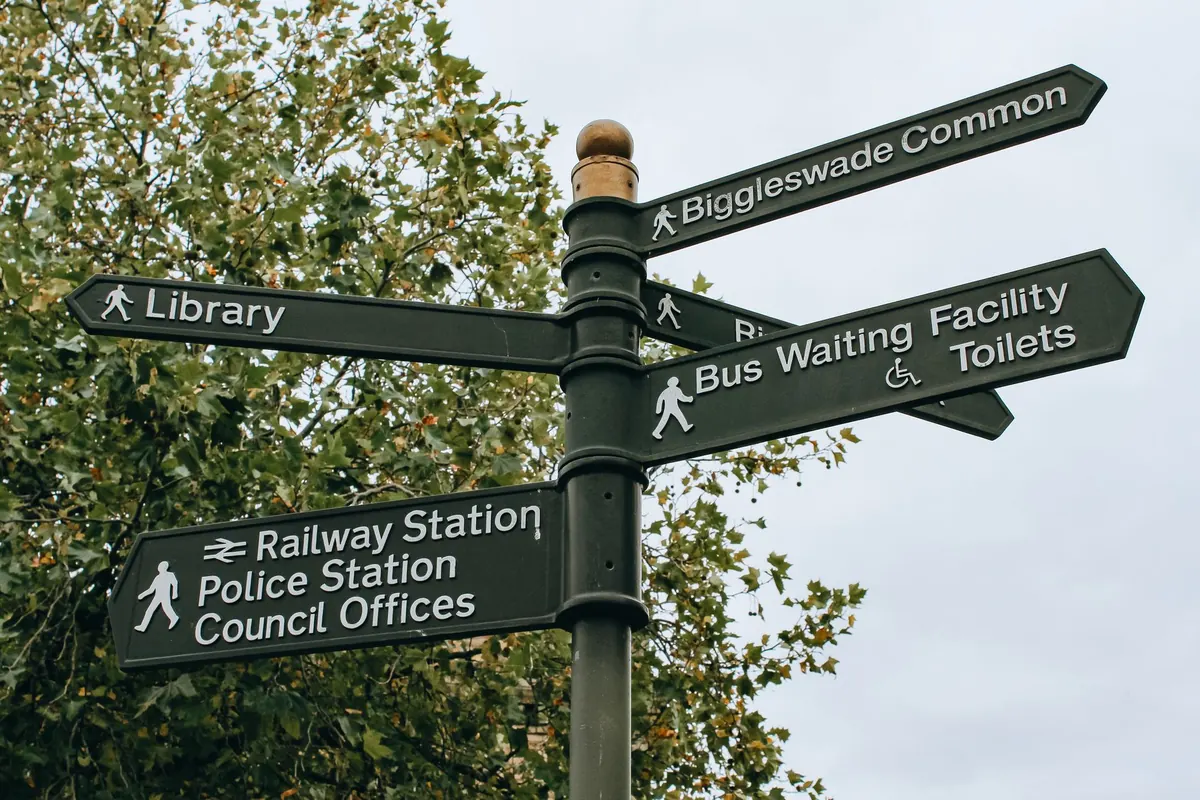
Fingerposts at road junctions often name the destination and may show the path type. But signs are not always present, and some are faded or missing. Never assume a path is open to bikes just because it looks wide enough. The definitive map — held by the local highway authority — is the legal record. You can usually view it online or at the council offices.
Horse riders can use bridleways, restricted byways and byways open to all traffic. Cyclists can use the same three, but not footpaths. On bridleways, cyclists should slow down and give way to walkers and riders, and warn others when approaching from behind. Dogs are allowed on all public rights of way, but keep them under control and on a lead around livestock. On open access land in England, dogs must be on a short lead between 1 March and 31 July to protect ground-nesting birds, and always near livestock.
Motor vehicles — including motorcycles — are only allowed on byways open to all traffic. Even there, a vehicle must be taxed, insured and roadworthy, and the driver must have the right to use the route. Many BOATs are subject to traffic regulation orders that restrict use at certain times or by certain vehicles. Check before you drive.
Not every path you walk is a public right of way. A permissive path is one the landowner allows you to use, often to link up a route or avoid a boggy field. The landowner can close it on set days (often a few days a year) or withdraw permission altogether. These paths may be waymarked in a different colour or with a small sign saying "permissive". Treat them as a privilege, not a right.
Open access land under the Countryside and Rights of Way Act 2000 covers much of England and Wales: mountain, moor, heath, down and registered common land. You can walk freely on it, but cycling and horse riding are only allowed on existing rights of way. Check local signs for any restrictions, such as lambing season or military training.
Paths can be temporarily closed for repairs, dangerous trees or events. A formal closure should be signed at each end, and a diversion may be waymarked. If you meet an obstruction — a locked gate, a fallen tree, an intimidating bull — you may go around it if that is reasonable and does not cause damage, but you must return to the path as soon as you can. Do not trespass deliberately.
Report obstructions to the local highway authority (the county council or unitary authority). They have a legal duty to keep public rights of way open. You can also report problems to the local Ramblers or British Horse Society group, who often have volunteers who check paths.
Scotland has a different approach. The Land Reform (Scotland) Act 2003 gives everyone statutory access rights to most land and inland water for walking, cycling, horse riding and other non-motorised activities, provided you act responsibly. So the footpath/bridleway distinction matters less, though public rights of way still exist. In Northern Ireland, public rights of way are recorded, but access to open country is more limited. Check with Walk NI or the local council before heading out.
A little preparation makes for a better day. Check an up-to-date map — Ordnance Survey Explorer or Landranger, or a reliable app. Look at the local authority's rights of way page for temporary closures. Wear footwear that suits the mud, and carry water and a waterproof. Tell someone where you are going and when you expect to be back.
Respect other users: give way to horses, keep dogs close, and leave gates as you find them. Take litter home, including fruit peel. If a path is unclear, follow waymarks rather than guesswork. And if you have a legal question about a specific path, contact the highway authority or a solicitor who specialises in rights of way. This guide is general information, not legal advice.
The more you understand the system, the more confident you will be on any trail. Yellow, blue, purple or red — each colour opens a different kind of day out.
Photo: Ethan Wilkinson / Pexels

Exploring woodland trails, walks, and outdoor adventures..
Copyright © 2026 Larch Loop. All rights reserved. Larch Loop.