October 08, 2026



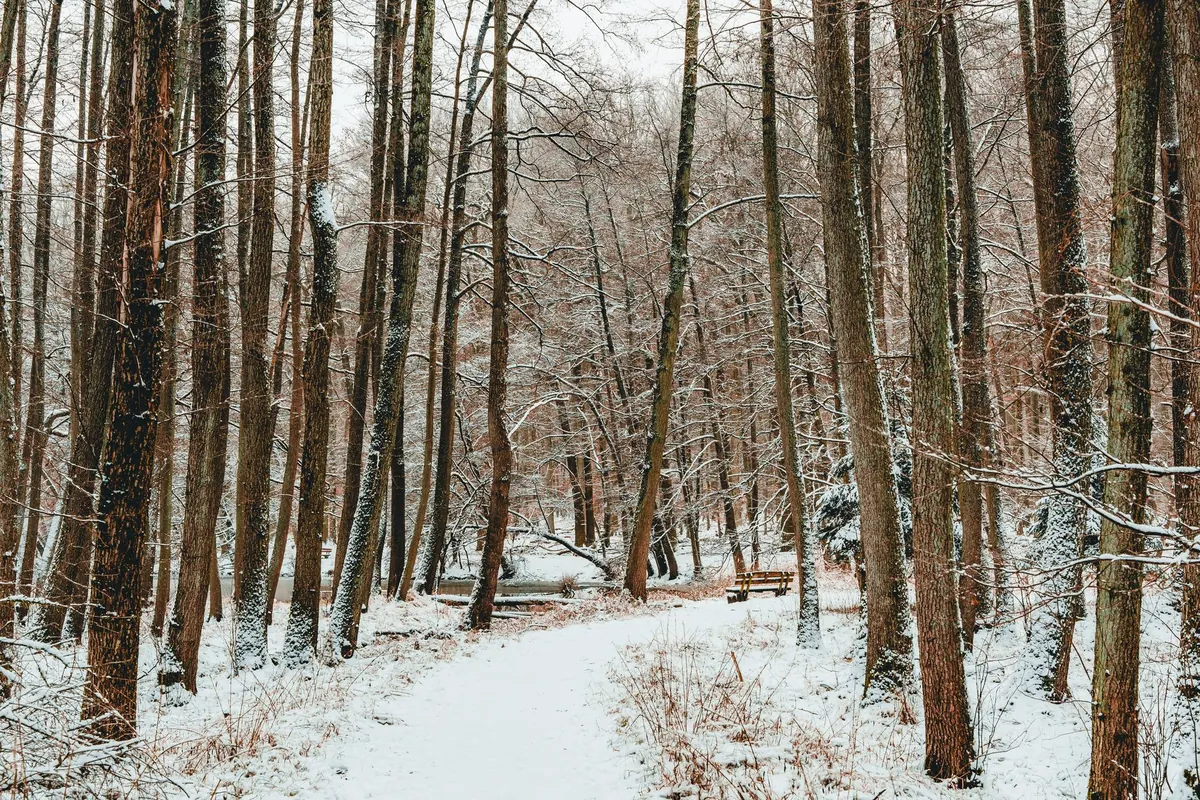
The woods are at their quietest in winter. With the leaves down you can see the shape of the place: the old boundary wall, the heronry, the way the ground falls towards the stream. But the same shade that keeps a beech wood cool in July keeps it frozen in January, and the mud that was merely annoying in November is often something closer to a skating rink by the gate.
Icy woodland is not like icy pavement. It hides under leaf litter, forms on boardwalks and roots, and frequently stays hard all day in deep shade. Walking it well comes down to three unglamorous things: grip underfoot, warmth you can actually manage, and a plan that finishes before the light does.
Open ground thaws. A field catching the low midday sun will soften within an hour or two of sunrise, and you can see exactly where you are putting your feet. A forestry track running north to south under mature conifers may not see direct sun at all between December and February.
Add meltwater trickling off the slopes, freezing overnight, then being polished by every pair of boots that passes, and you get the classic winter woodland surface: a thin, glassy glaze that looks like wet gravel. Leaf litter is the worst of it. Beech and oak leaves hold a layer of ice beneath them, so a stretch that looks soft and brown gives no warning at all.
Watch particularly for:
On a genuinely icy day, swap ambition for enjoyment. A wide forest road with a gentle gradient and a few metres of clearance either side is a far better bet than a narrow singletrack path along a gorge. If the route includes a steep descent, a river crossing or a section of exposed ridge, save it for a milder week — a descent is where most slips happen, because that is where people relax.
Out-and-back options are underrated in winter. A loop commits you to completing the circuit; a there-and-back route lets you turn round at any point without a navigational penalty. Pick a turning point before you set off, tell someone at home what it is, and stick to it. Low-level, well-trodden paths near a village or a car park are also easier to exit from quickly if the weather closes in.
There is no single answer here, because ice comes in different forms. A pair of strap-on spikes with a handful of short steel points is the most useful piece of winter kit for woodland walking. They bite into hard-packed snow and glazed mud, and they pack small enough to live in the bottom of a rucksack from November to March.
Coil-and-spring devices are lighter and fine on pavements and light ice, though they struggle on a sloping forest track where you need real purchase. Full mountaineering crampons belong on winter hills, not on a lowland trail, and they need stiff-soled boots and the skill to use them properly.
Try them on at home, over the boots you actually wear, before you need them. Straps should be snug but not crushing the boot, and the points must sit under the sole rather than creeping round the side. Take them off for tarmac, rock slabs and car parks: metal points skid on bare stone and blunt quickly on hard ground.
Once they are on, change how you walk. Shorten your stride, keep your feet flat rather than rolling off the toe, and place each foot deliberately. Walking poles add two more contact points, take weight off tired knees on descents and give a huge amount of confidence back on a greasy path. Keep them slightly longer than you would in summer.
Woodland walking is not steady effort. You stop for a photo, a map check, a gate, a chat. You overheat on the climb and chill the moment you stop. The fix is a system you can adjust in seconds without taking your rucksack off.
Start with a synthetic or merino base layer — never cotton, which stays wet and cold against the skin. Add a fleece or light synthetic mid-layer, and carry a second, thinner one if the forecast is brutal. Your outer layer should be a waterproof shell with pit zips, so you can dump heat on the uphill without exposing your arms.
On your legs, a softshell or light walking trouser plus gaiters beats bulky insulated trousers, which are miserable once you warm up. For hands, take liner gloves and a warmer pair, and keep a spare in a dry bag: cold hands are the most common reason a winter walk ends early. Feet need boots with room for a thicker sock, plus a spare pair of socks in the pack.
Food and drink matter more than people expect. Carry a flask of something hot, eat before you feel hungry, and take a small foam sit mat so you can stop for ten minutes without your backside going numb. A square of closed-cell foam costs nothing and weighs almost nothing.
In midwinter, it is often dark by half past four across much of the UK, and under a dense conifer canopy the useful light goes earlier still. So plan backwards. Decide what time you want to be back at the car, work out how long the route takes at winter pace — slower, because of the surface — and add an hour for stops and any detours.
Then start earlier than feels natural. A walk that would be a pleasant afternoon outing in June can turn into a torch-lit fumble in January. Carry a head torch with spare batteries and a small hand torch as backup, and treat the last half-hour of daylight as a buffer rather than walking time. If you are out longer than planned, tell whoever is waiting.
Cold creeps up quietly. Watch for hands that will not warm up, persistent shivering, clumsy feet, slurred or slow speech, and unusual drowsiness or confusion. Those last signs are serious: get the person out of the wind, into dry layers and a sleeping bag or foil blanket, give a warm drink if they are fully alert, and call for help — 999 — rather than pressing on.
Frostbite is easier to avoid than treat. Numb, white, waxy fingers or toes need gentle warming, not rubbing with snow or holding against a hot stove. And if you have a heart or lung condition, or you are coming back from illness, it is worth a word with your GP before heading out in serious cold. Cold weather puts extra strain on the body, and that is worth respecting.
Keep it simple and repeatable. Spikes and a head torch live in the rucksack from November to March. Spare gloves and socks live in a dry bag. You check the forecast the night before and again at the car, choose a low, wide, gently graded route, set a turnaround time, and tell someone where you are going. Then walk shorter steps, stop often, eat properly, and enjoy the fact that you have the beech wood entirely to yourself.
Go early, go gently, and turn round while you are still enjoying it. That is the whole trick.
Photo: Masood Aslami / Pexels

Exploring woodland trails, walks, and outdoor adventures..
Copyright © 2026 Larch Loop. All rights reserved. Larch Loop.