October 08, 2026


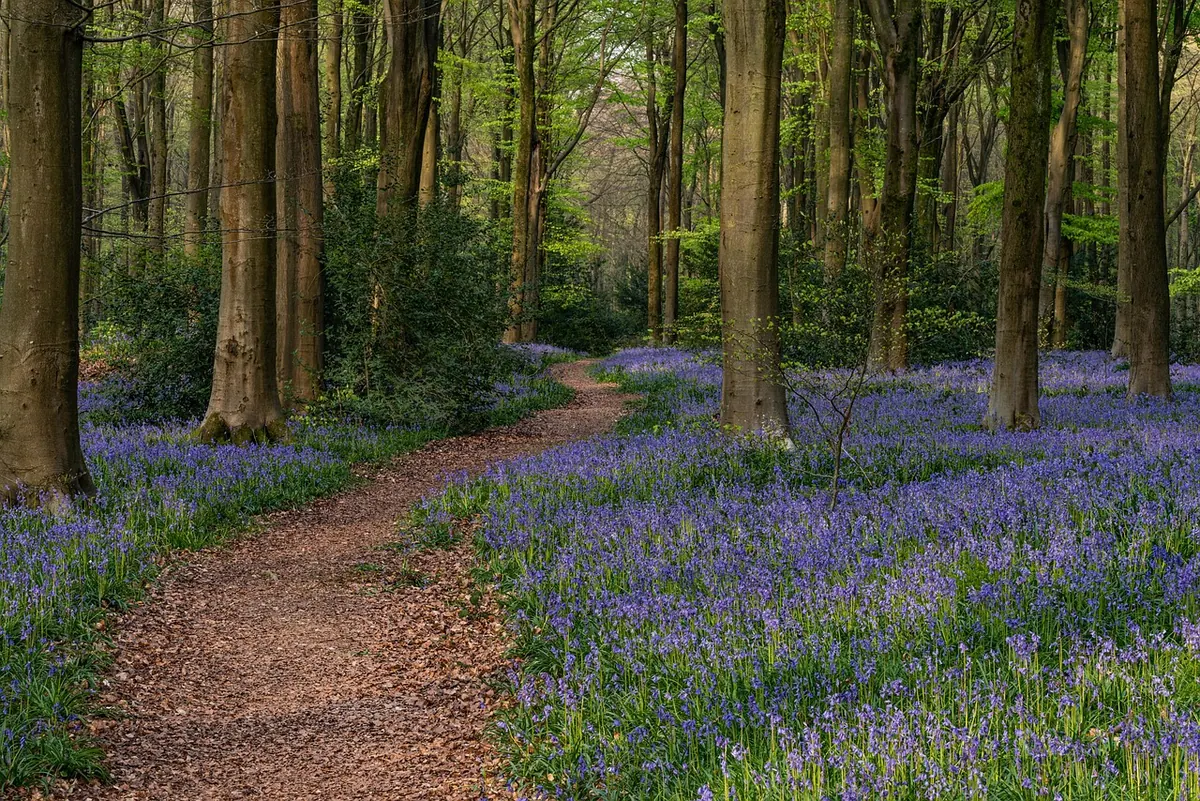
Bluebell season is short, local and easily spoiled by one careless boot. Get the timing right and an hour in the right wood in late April or May is one of the best free days out in Britain. Get it wrong and you will find bare ground, brown stems, or a car park full of disappointed photographers. What follows is how to read a wood before you travel, how to walk it kindly, and how to photograph the blue without flattening it.
Across most of lowland England and Wales, the main flush runs from roughly the third week of April into mid-May. Sheltered coastal woods in Cornwall, Devon, Pembrokeshire and the south coast can be blue by mid-April. The same species in Northumberland, the Pennines or Highland glens may not peak until mid-May, and in cold upland woods you can still find colour in the first days of June.
Within a single wood, flowering moves like a slow tide. South-facing banks, sunny edges and the fringes nearest the gate always open first, because they warm up fastest. North-facing slopes and shaded hollows hold colour longest, which is often where the best photographs are hiding a week after the main show has faded elsewhere. Altitude matters too: a wood on a hillside can sit a week or more behind one in the valley below. A cold, dry spring pushes everything back; a mild, damp one brings it forward.
Each colony flowers for about three to four weeks, but the deep blue peak — when the whole floor seems to glow — often lasts only ten days or so. The canopy is the real clock. Bluebells open before the trees leaf up, then get shaded out once the wood is in full leaf, and the show is over for another year.
Guidebook dates are a starting point, not a promise. Before you drive an hour to a famous wood, do twenty minutes of homework. Wildlife trust reserve pages, National Trust and Woodland Trust wood listings often say whether the bluebells are out, and a quick look at recent photographs from local naturalists will tell you whether you are looking at buds or a full carpet.
If you have a wood near home, walk it once in early April and note the stage. You will then be able to predict it in future years better than any website can:
The flowers are what you notice; the damage is usually done to the leaves and the soil beneath them. Bluebell bulbs sit shallowly, and the leaves do the work of feeding next year's flower. A crushed patch can take years to green over, and a popular wood can be worn bare at its entrances by a single busy weekend. The good news is that protecting them requires almost no effort.
If you can see where you have walked afterwards, you have probably wandered too far off the path.
Blue is a difficult colour for cameras, and midday sun is its worst enemy. Strong overhead light flattens the carpet, wipes out the depth and turns rich violet into a dull grey-blue. Overcast mornings, dappled shade and the hour after sunrise give the colour something to sit against. A shaft of light falling across a shaded foreground will do more for your picture than any amount of fiddling with settings.
Practical habits that work:
The bluebell in a British wood is usually the native Hyacinthoides non-scripta: deep violet-blue, with flowers hanging mostly on one side of a nodding stem, narrow strap-like leaves, creamy white pollen and a strong sweet scent. The Spanish bluebell, common in gardens, stands upright with flowers all round the stem, is paler blue or pink, has broad leaves, greenish pollen and very little scent. The two cross-breed, and the hybrids dilute native populations.
If a reserve asks visitors to report pale or upright bluebells, do it. It is one of the simplest ways a walker can help. It is also worth knowing that a wood full of native bluebells is usually an old one: the species spreads very slowly and is a classic indicator of ancient woodland.
Bluebells rarely grow alone. Look for wood anemone, wood sorrel, early purple orchid, dogs mercury and the sharp green smell of wild garlic, all of which suggest the same long-undisturbed ground. This is also the loudest month for birdsong: listen for blackcap, chiffchaff and nuthatch, and watch the canopy close above you as the weeks pass. Walking the same wood in early April, late April and mid-May teaches you more about the season than any calendar.
Finally, treat any wood you visit as someone else's careful work. Many bluebell woods are managed by volunteers, funded by memberships and donations, and dependent on visitors who close gates, follow signs and keep their feet where the path already is. Enjoy the blue while it lasts, and leave it to come back.
Photo: ebor / Pixabay

Exploring woodland trails, walks, and outdoor adventures..
Copyright © 2026 Larch Loop. All rights reserved. Larch Loop.